Total Wrist Replacement
Total wrist replacement is the modern alternative to fusion for advanced arthritis: it relieves pain while preserving movement of the wrist — a crucial advantage for everyday hand function.
When it is indicated
- Post-traumatic wrist arthritis (e.g. advanced SLAC/SNAC changes)
- Rheumatoid arthritis
- Degenerative osteoarthritis with persistent pain
- Failure of previous salvage procedures
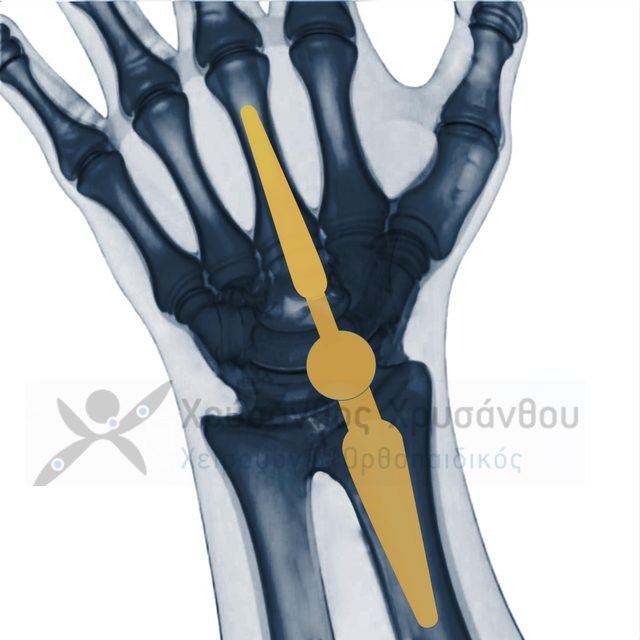
The operation
The worn joint surfaces are replaced with a modern total wrist replacement system (Motec® type), designed to provide stability and a functional, pain-free range of motion. In selected cases alternative salvage procedures are also considered — the decision is always individualised.
Realistic expectation: wrist replacement usually restores about half of the normal range of motion — enough for most daily activities, with the main gain being pain relief and preserved movement instead of complete immobilisation (fusion). Hospital stay: short — usually up to one night.
What you should know — before & after the operation
The outcome of this operation is directly linked to your own effort in rehabilitation — the guidance below is general and is individualised by your doctor and therapist.
Before the operation
- Full pre-operative work-up and anaesthetic assessment.
- Smoking: smokers have more frequent complications (delayed tissue healing, infections) — stopping, even temporarily, significantly improves the outcome.
- Tell your doctor about all your medication, especially anticoagulants and antiplatelets.
- Arrange help for the first weeks — the hand will be in a plaster/splint and you will only do light activities.
- Arrange transport home from the clinic.
After the operation
- Initially a plaster; at ~2 weeks it is replaced with a lighter splint, worn continuously for a further 4 weeks — removed only for washing and exercises.
- With the splint, light activities are allowed (phone, washing, dressing) — no heavy use or weight-bearing on the hand.
- Absorbable sutures fall out by themselves in ~2 weeks; non-absorbable ones are removed then.
- After full healing: daily scar massage with moisturising cream, in deep circular movements — prevents hypersensitivity and tendon adhesions.
- Exercises are done 5 times a day (5–10 repetitions each), gently and slowly — discomfort is normal, pain is not.
Hand up high — the golden rule of the first weeks. Keep the hand elevated to prevent swelling and finger stiffness: do not walk with the hand hanging at your side and do not sit with the hand resting in your lap.
The recovery journey — indicative timeline
Weeks 0–2
Plaster, hand elevated, light activities only
Weeks 2–6
Light splint continuously; exercises 5×/day, scar massage
Week 6
Surgeon review; weaning off the splint by day, driving once approved
~Week 12
Return to most daily activities
Months 3–6
Heavy activities and sports, gradually and individually
Recovery from this operation is gradual — the outcome depends directly on consistency with the exercises and your therapist’s instructions.
Safety & possible complications
Every operation carries some degree of risk — it is important to be aware of them and to ask freely about anything that concerns you.
• any hand operation
Swelling & finger stiffness
Prevented by elevating the hand and moving the fingers regularly from the start.
Infection
Higher in smokers; a superficial infection is usually treated with antibiotics.
Sensitive / adherent scar
Daily scar massage prevents hypersensitivity and adhesions to the tendons.
Nerve injury
Small risk to the nerves and superficial branches of the area; usually temporary symptoms.
Complex regional pain syndrome (CRPS)
Rarely, an exaggerated pain/stiffness reaction of the hand; recognised and treated early with intensive therapy.
Anaesthetic
Nausea relatively common; serious complications very rare.
• wrist replacement
Limited range of motion
Movement is restored to about half of normal — enough for daily life; the goal is mainly a pain-free, functional wrist.
Implant loosening / subsidence
Like any replacement, it has a finite lifespan; joint protection and avoiding heavy loading prolong it.
Instability / dislocation
Rare with modern systems; may need further treatment.
Revision
If needed, the fallback of conversion to fusion always remains — so replacement does not “burn bridges”.
Frequently asked questions
01 How much movement will I regain in my wrist?
Realistically, about half of the normal range of motion — which is nonetheless enough for most daily activities. The big gain is a pain-free wrist that still moves, unlike fusion, which abolishes movement permanently.
02 What splints will I wear and for how long?
Initially a plaster for about 2 weeks. Then a lighter splint, continuously for a further 4 weeks — you remove it only for washing and for your exercises. From week 6, and once the surgeon confirms the implant is stable, you gradually remove it during the day and keep it at night and in “risky” situations (crowds, public transport) for another 2 weeks.
03 What exercises will I do?
A programme shown to you by the therapist, 5 times a day with 5–10 repetitions: free shoulder and elbow movements, making a fist and finger and thumb movements, gentle wrist movements back-forward and side-to-side, forearm rotations (palm up-down) with the elbow fixed, and the characteristic diagonal “dart-throwing” movement. Always gently and slowly — discomfort is expected, pain means gentler and fewer repetitions.
04 The exercises hurt — what do I do?
Try gentler, smaller movements with fewer repetitions and a gradual increase. Once the wound has fully healed, warming the hand in lukewarm water or with a heat pack before exercises helps pain and stiffness. If the problem persists, discuss it with your therapist.
05 Why is scar massage important?
Once the wound has fully healed, massage the scar daily with a little moisturising cream, in deep circular movements, for up to 6 months. It keeps the scar supple as it matures, prevents hypersensitivity and stops the tendons “sticking” to the surrounding tissues — which would make hand movement harder.
06 I smoke — does it matter?
Yes, a great deal. Smokers have more frequent complications after hand surgery, such as delayed tissue healing and infections. Stopping — ideally weeks before the operation and for the duration of healing — substantially improves the outcome. Ask for help to quit if you need it.
07 When can I drive?
Most patients return to driving about 6 weeks later — always in consultation with the surgeon or therapist. The requirement: you must control the vehicle safely, including an emergency stop. Avoid long journeys at first.
08 When do I return to work and heavy tasks?
Recovery is gradual: at ~12 weeks you return to most daily activities, while heavy tasks (lifting full bags, vacuuming) and sports may take 3–6 months. The time to return to work depends on its nature — discuss it individually.
09 How do I protect the implant long-term?
Follow the joint-protection principles your therapist will show you: avoid repetitive heavy loading and pushing your body weight through the hand, use the large joints for weights, and use aids where needed. This maximises the lifespan of the replacement.
10 When will I see the doctor again?
Wound/suture check at ~2 weeks (together with the change to a lighter splint) and a routine review by the surgeon at ~6 weeks, where implant stability is checked and the exercise programme progresses. Report fever, marked redness, swelling or discharge from the wound immediately.
Why choose Dr. Chrysanthou
Certified specialist training in total wrist replacement and daily involvement in hand and wrist surgery — as Head of the Upper Limb Unit at the Interbalkan Medical Center, with 17+ years of experience in orthopaedic and reconstructive surgery.
Persistent wrist pain? There are modern solutions that preserve movement.