Thumb-Base Replacement (CMC-1)
Basal thumb arthritis — arthritis at the base of the thumb — is one of the most common causes of hand pain. Total CMC-1 replacement replaces the joint while preserving movement, thumb length and grip strength, with faster recovery than the classic techniques.
When it is indicated
- Persistent pain at the thumb base that does not settle with conservative measures
- Weak grip and difficulty with everyday tasks (opening a jar, a key, writing)
- Advanced basal thumb arthritis confirmed on X-ray
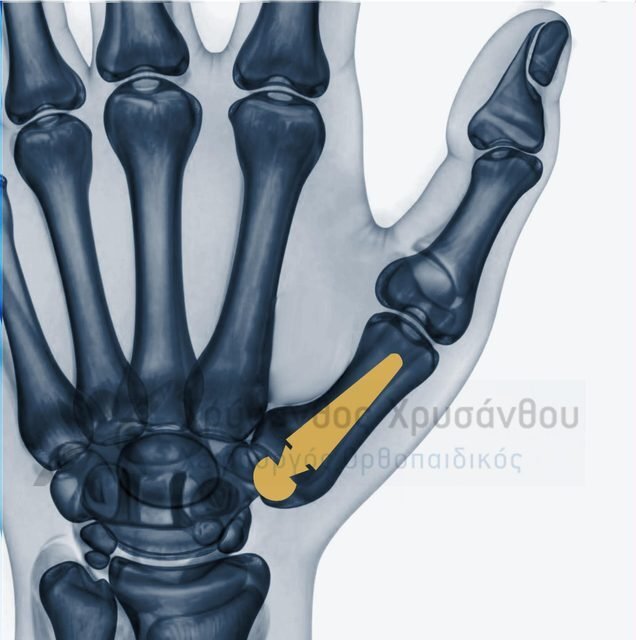
The joint at the base of the thumb
The thumb is what makes the human hand unique — it lets us grasp, hold and handle objects. At its base lies the carpometacarpal joint (CMC-1), connecting the first metacarpal to a small wrist bone, the trapezium; it is one of the most mobile joints in the body. When its protective cartilage wears away (basal thumb arthritis), the bones rub against each other, causing pain, stiffness, swelling and loss of grip strength. It is an extremely common condition — especially in women over 40 and in people who use their hands heavily at work or in their hobbies.
The operation
The worn joint is replaced with a modern ball-and-socket total implant (TOUCH® type) — cementless, with dual-mobility technology for increased stability: essentially a “miniature” hip replacement at the base of the thumb, in clinical use in Europe for more than a decade. Compared with traditional trapeziectomy, in suitably selected patients it preserves thumb length, movement and grip strength, with faster recovery.
Hospital stay: short — usually day-case or with one overnight stay.
Before you decide
Treatment options for basal thumb arthritis
Not all basal thumb arthritis needs treatment — in many people symptoms come and go. But when pain persists and interferes with everyday tasks (a key, a jar, writing), there is a full spectrum of solutions:
Conservative
Other surgical
Total replacement
The choice is always individualised and decided together with you, after a full clinical and radiological assessment.
What you should know — before & after the operation
Before the operation
- Full pre-operative work-up and anaesthetic assessment.
- Tell your doctor about all your medication, especially anticoagulants and antiplatelets.
- The hand will have a special dressing for the first ~2 weeks — arrange help with daily tasks.
- Remove rings and jewellery from the operated hand; arrange your transport.
After the operation
- A special dressing for the first ~2 weeks (15 days), removed at the clinic together with the wound check — no plaster.
- A thermoplastic splint is fitted, worn in total for ~8 weeks after surgery, and thumb exercises begin with the physiotherapist.
- Exercises are done roughly every 2 hours, removing the splint only for them — discomfort is allowed, pain is not.
- After healing: scar massage 3–5 minutes, 4 times a day (with a little moisturiser), and optionally exercises in warm water for 5 minutes — reducing swelling, stiffness and hypersensitivity.
- Watch the wound for signs of infection: redness, warmth, swelling, discharge or fever → contact us immediately.
No tight grip — the rule of the first 6 weeks. Avoid firm gripping, “pinching” with the thumb and lifting objects with the operated hand, so the implant integrates smoothly. Strength is built later, with the strengthening programme.
The recovery journey — indicative timeline
Weeks 0–2
Special dressing, hand elevated; light activities only
Weeks 2-6
Splint continuously; gentle exercises every 2 hours, scar massage — no gripping/lifting
Weeks 6-8
Splint only at night and during activities; light tasks (dishes, cutlery)
Weeks -12
Strengthening 2–3 times/week with rest days; gradual weaning off the splint; driving with a comfortable grip
Months 3–6
Full daily use; the splint only as extra support for heavy tasks, if needed
Never push into pain — progress is gradual, under the guidance of your therapist.
Safety & possible complications
Complications are rare, but you should be aware of them — some may require re-operation. Feel free to ask anything that concerns you.
• Surgery-related
Infection (early or late)
Watch for redness, warmth, discharge or fever — early treatment has a better outcome.
Haematoma / prolonged pain
Usually self-limiting; managed conservatively.
Tendinitis
De Quervain’s tenosynovitis or “triggering” of the thumb — treatable conditions of the neighbouring tendons.
Neurological symptoms
Altered sensation (numbness or tingling) in the area; usually temporary.
Complex regional pain syndrome (CRPS)
An exaggerated pain/stiffness reaction in the first months; recognised and treated early.
• Implant-related
Loosening / component migration
Like any replacement; part or all of the implant may need replacing.
Mechanical complications
Dislocation, early wear or component fracture — dual-mobility technology reduces the risk of instability.
Osteolysis / peri-operative fracture
Bone resorption around the implant or a fracture during/after surgery — managed individually.
Calcifications
New bone or calcium deposits forming around the joint — rarely of any clinical significance.
Allergic reaction
A reaction to the implant materials; tell us before surgery about any known metal allergies.
Functional limitations
Reduced range, stiffness or painful movement; addressed with the therapy programme.
Συχνές ερωτήσεις
01 What exercises will I do in the first weeks?
Simple, gentle movements shown by your therapist, roughly every 2 hours with the splint off: moving the thumb away from the index finger with the palm down (or lifting it towards the ceiling), forming an “L” with the hand on its side, touching the thumb to the tip of each finger in turn, and gentle circles with relaxed fingers — about 10 repetitions each. Discomfort is allowed, pain is not.
02 When does strengthening start?
From about week 8, with guidance: first static exercises (pressing the thumb without movement, 5–10 seconds, 5–10 repetitions) and, once these become easy, dynamic ones with an elastic band. They are done 2–3 times a week, with rest days in between — and never into pain.
03 Why scar massage and how is it done?
Once the wound is dry and healed: first get used to touching it, then apply pressure with circular movements so the skin moves, optionally with a little moisturiser — 3–5 minutes, 4 times a day. It reduces swelling, improves movement, softens the scar and desensitises the area.
04 When can I drive?
When you have regained a comfortable, safe grip on the wheel — for most patients this is around the 8–12 week period, always in consultation with your doctor or therapist.
05 Why a replacement and not a trapeziectomy?
Trapeziectomy (removal of the trapezium) remains an established solution. In suitably selected patients, however, total replacement preserves thumb length, movement and grip strength, with faster overall recovery. The choice is individualised based on your anatomy, bone quality and demands — and if it is ever needed, trapeziectomy remains available as a fallback.
06 Will the implant need replacing in the future?
Like any replacement, it has a finite lifespan — over time your surgeon may consider replacing part or all of it. Regular follow-up ensures any wear is detected early.
07 Can I travel with the implant?
Yes, normally. It is advisable to carry a copy of an X-ray showing the implant — depending on the country and the security-gate settings, the implant may be detected at checks.
08 Should I mention the implant at medical examinations?
Yes — at every examination (MRI, CT, X-rays) inform the healthcare professional about the presence of the implant. In addition, no injection should be given near the implant.
09 My thumb hurts / I knocked my hand — what do I do?
Consult your surgeon in case of pain, “unusual behaviour” of the implant, signs of infection, or after an injury or fall on the hand. Do not wait for it to “go away on its own”.
10 When will I see the doctor again?
At ~2 weeks (15 days) to remove the special dressing, check the wound and fit a splint, and then at regular follow-ups to confirm the implant is working properly — the review schedule is set individually.
Why choose Dr. Chrysanthou
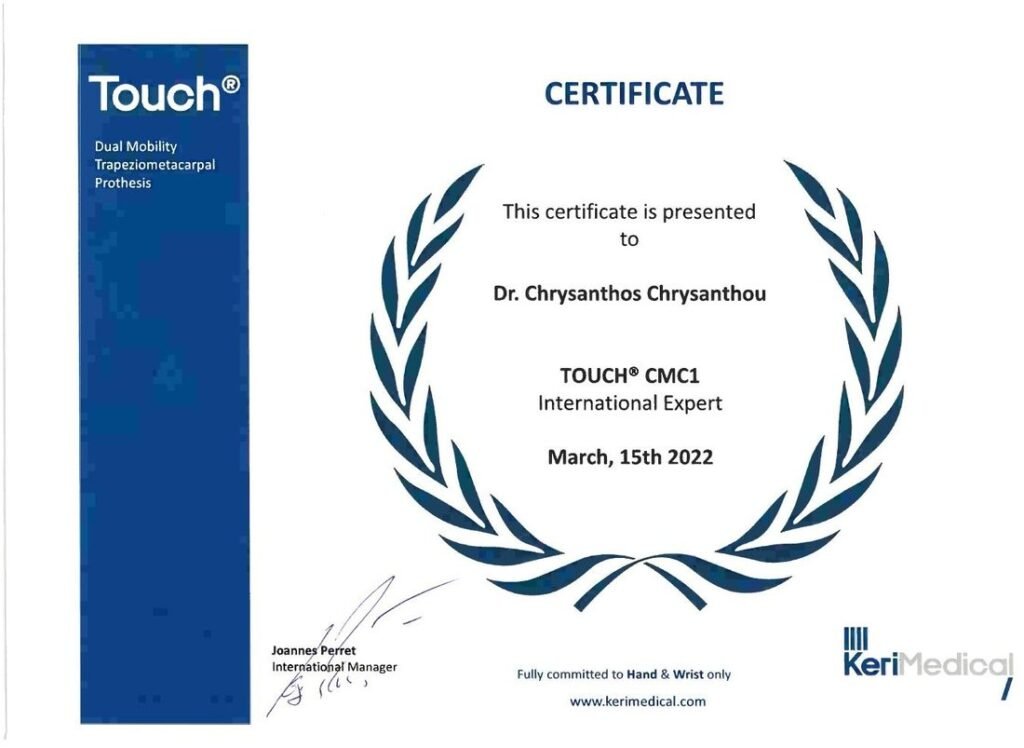
CMC-1 replacement is a core part of his practice: he sub-specialised in France and is an international trainer in this procedure, holding the internationally recognised TOUCH® CMC1 International Expert certification (KeriMedical, 2022) — one of only a few such certifications worldwide — backed by 17+ years of experience in hand and upper-limb surgery.
Πονάει η βάση του αντίχειρα; Είναι από τις πιο αποτελεσματικά αντιμετωπίσιμες παθήσεις του χεριού.