Knee Replacement
Total and partial (unicompartmental) knee replacement with robotic assistance, focusing on the right patient selection, preservation of natural movement and a faster return to activity.
When it is indicated
- Advanced knee osteoarthritis with pain that limits daily life
- Isolated single-compartment wear — a candidate for partial replacement (UKA)
- Post-traumatic or inflammatory arthritis
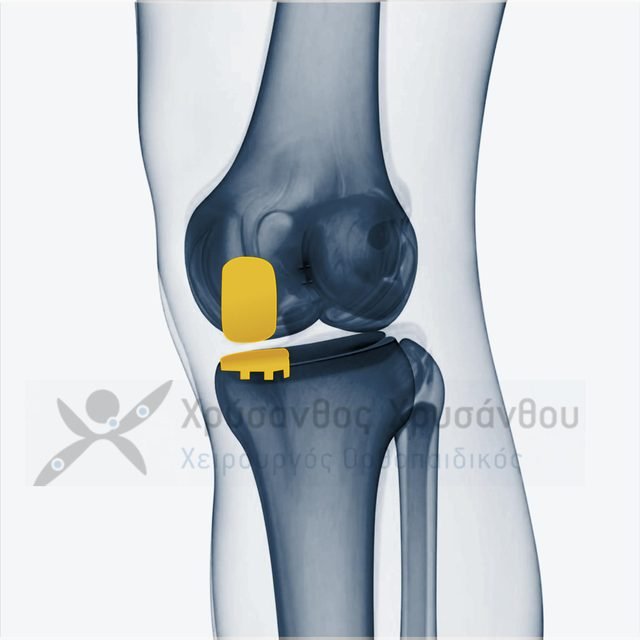
Οι τρεις τύποι επέμβασης στο γόνατο
The choice depends on the extent of wear, the state of the ligaments and the knee’s history — and is individualised after a full clinical and imaging assessment.
Total knee replacement
WHAT IT IS
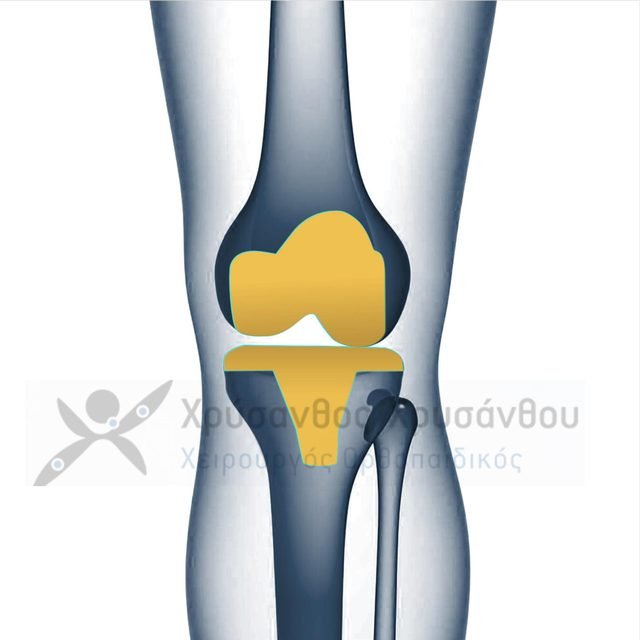
The worn joint surfaces of the femur and tibia (and, where needed, the patella) are replaced with metal implants and a special polyethylene insert. It is indicated when arthritis affects more than one compartment. With robotic assistance, placement is planned individually and executed with maximum accuracy and optimal soft-tissue balance.
HOSPITAL STAY
Usually 2–3 nights. You stand and walk with an aid from the very first day — early mobilisation is part of the protocol.
Unicompartmental (partial) replacement
WHAT IT IS
When wear is confined to a single compartment (usually the inner one) and the ligaments are intact, only the affected part is replaced. The cruciate ligaments and the healthy parts of the joint are preserved — the knee “feels” more natural, the incision is smaller and blood loss is less. Dr. Chrysanthou has a high volume and specialist training in the technique.
HOSPITAL STAY
The shortest of the three — usually 1–2 nights, with faster overall recovery and return to activity
Revision knee replacement
WHAT IT IS
The replacement or correction of a previous replacement that developed a problem: implant loosening or wear, instability, stiffness or infection. It is a more complex operation — it involves removing the old materials, reconstructing any bone defects and fitting special revision implants (with stems and metal wedges where required). It demands specialist experience and careful pre-operative planning.
HOSPITAL STAY
Longer — usually 3–5 nights, with an individualised rehabilitation program depending on the reason for the revision.
Robotic assistance — MAKO, ROSA, CORI
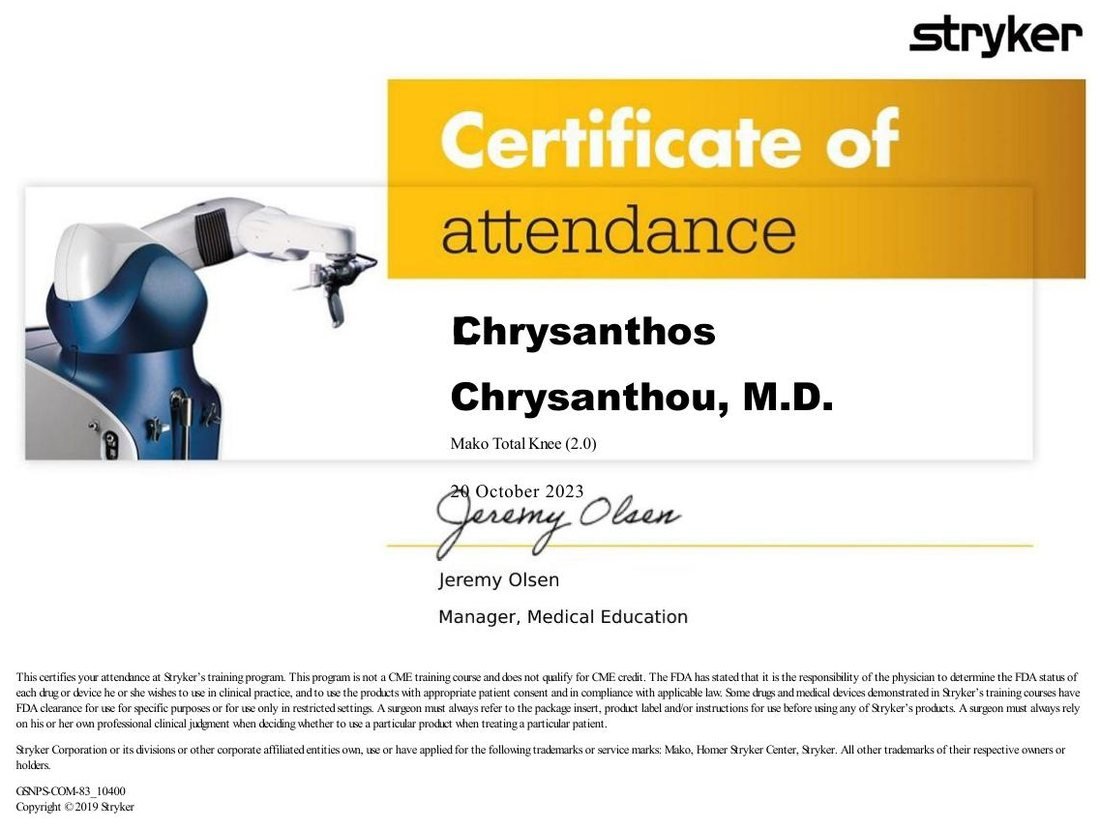
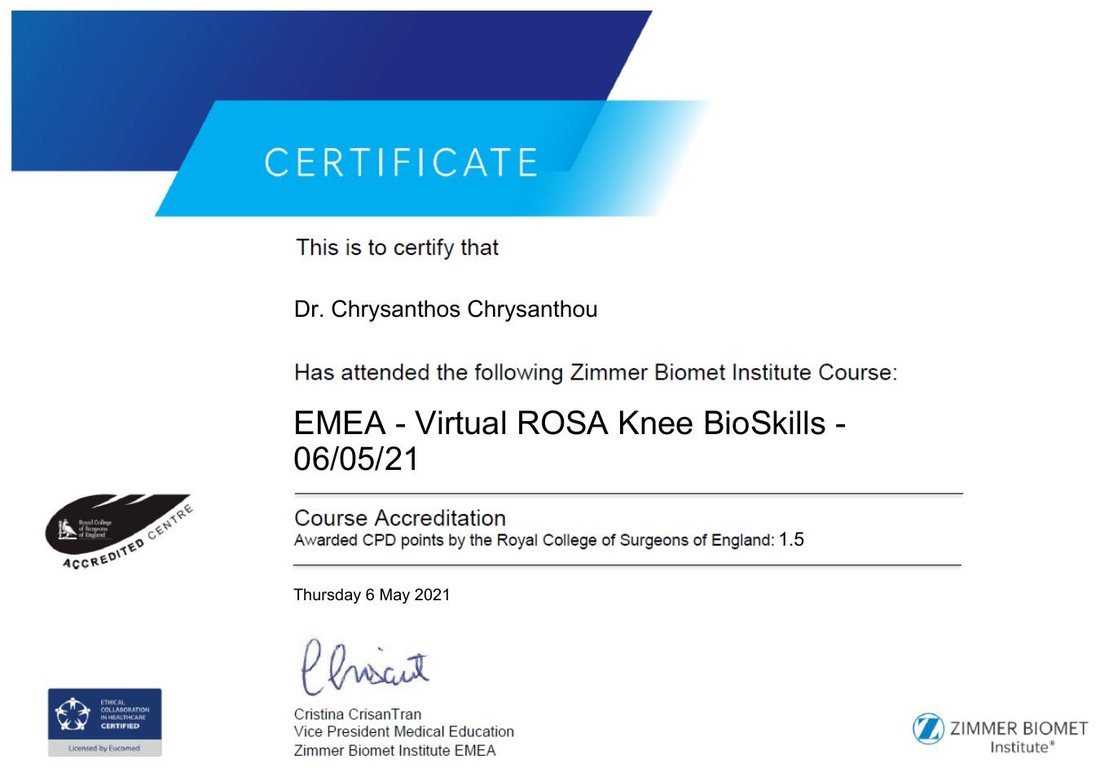
Dr. Chrysanthou has completed certified training and has hands-on experience in all three leading robotic knee systems — with his training on the MAKO SmartRobotics system carried out at Stryker’s facilities in Florida, USA. The operation is planned individually on your anatomy, the cuts are executed with millimetre robotic precision and ligament balance is checked objectively in theatre — factors linked to a more predictable functional outcome and a smoother recovery, in both total and partial replacement.

What you should know — before & after the operation
Before the operation
- Full pre-operative work-up and anaesthetic assessment; treat any sources of infection (teeth, urinary tract) before surgery.
- Tell us about all your medication — especially anticoagulants and antiplatelets.
- “Pre-habilitation”: strengthening the quadriceps before surgery speeds up recovery afterwards.
- Prepare your home: remove rugs and cables, ensure a stable chair with arms and easy access to bathroom/bed.
- Arrange transport and help for the first 1–2 weeks.
After the operation
- Standing and walking with an aid from day one; gradual progression to crutches and then without an aid.
- Thromboprophylaxis: anticoagulation and compression stockings for the period your doctor specifies.
- Ice packs and leg elevation to control swelling — the knee “swells” for weeks, which is expected.
- Daily range-of-motion and quadriceps exercises — the goal is full extension early and flexion over 90° in the first weeks.
- Waterproof dressing on the wound; sutures/clips removed at 10–14 days; follow-up at 2–3 and 6 weeks.
Full extension early — and never a pillow under the knee. A straight knee (0°) is the foundation of a good result: it keeps your gait normal and prevents a permanent bend. When you rest, the pillow goes under the ankle — not under the knee
The recovery journey — indicative timeline
Day 0–1
Standing and first steps with an aid — early mobilisation
Weeks 1–2
At home with crutches; exercises daily; sutures 10–14 days
Weeks 2-6
Gradual weaning off aids; stationary bike; driving ~4–6 weeks once approved
Weeks 6-12
Desk work, walking, swimming, cycling
Months 3–12
Full activity and gentle sports; improvement continues up to 12 months
In partial replacement the times are generally shorter; in revision they are fully individualised.
Safety & possible complications
Knee replacement is one of the most studied and successful operations — but, like any surgery, it carries risks you should be aware of.
• General — any operation
Pain & swelling
Controlled with regular analgesia, ice packs and elevation; swelling can persist for weeks.
Thrombosis (DVT / pulmonary embolism)
Systematically prevented with anticoagulation, stockings and early mobilisation.
Infection
Superficial or, more rarely, deep in the joint; early diagnosis is decisive — report fever, redness or discharge immediately.
Bleeding
Minor oozing is common; significant bleeding or transfusion is rare.
Neurovascular injury
Small risk to the nerves and vessels of the area.
Anaesthetic
Nausea relatively common; serious complications very rare.
• Specific — knee replacement
Stiffness / arthrofibrosis
The main reason exercises are non-negotiable; rarely, manipulation under anaesthesia is needed.
Numbness beside the incision & “clicking”
A small area of numbness next to the incision and mild sounds from the implant are common and do not indicate a problem.
Anterior knee pain
Symptoms around the kneecap may persist; they usually improve with strengthening.
Loosening / wear over time
Modern implants have excellent longevity — the great majority work perfectly for 15–20+ years.
Instability
A feeling that the knee “gives way”; robotically controlled ligament balancing reduces the risk.
Periprosthetic fracture
A fracture around the implant; it may require surgical treatment.
Frequently asked questions
01 When will I walk after the operation?
The same or the next day, with the help of a physiotherapist and a walker or crutches. Early mobilisation is part of the modern protocol — it reduces the risk of thrombosis and speeds up recovery.
02 What do I gain from the robotics?
Personalised planning on your own anatomy, millimetre accuracy in implant placement and objective checking of ligament balance during surgery. These are linked to a more “natural” feeling knee, less tissue trauma and a more predictable outcome.
03 Total or partial — how is it decided?
Based on the extent of wear and the state of the ligaments, as seen on clinical examination and imaging. If only one compartment is affected and the cruciates are intact, the partial replacement offers a more natural knee and faster recovery; if the wear is extensive, the total is the right solution. The decision is finalised individually.
04 How much will I hurt and for how long?
Post-operative pain is controlled with combined analgesia and gradually subsides over the first weeks. Swelling and a feeling of “tightness” may persist for 2–3 months — this is a normal part of healing. Ice packs and elevation help significantly.
05 How long does a knee replacement last?
Modern implants have excellent longevity: according to international registries, the great majority work perfectly for more than 15–20 years. Accurate placement — where robotics helps decisively — and a healthy body weight prolong it.
06 Will I be able to kneel?
Kneeling does not harm the implant — but for many patients it remains uncomfortable as a sensation, especially over the scar. Over time and with a soft surface, most manage it for short activities.
07 When can I drive?
Usually at 4–6 weeks, once you have stopped strong painkillers, fully control the leg and can perform an emergency stop safely — always with your doctor’s approval. Also inform your insurance company.
08 Which sports can I return to?
Low-impact activities are encouraged: walking, swimming, cycling, golf, gentle hiking, dancing. Running, jumping and sports with sudden turns are best avoided consistently, as they accelerate wear of the implant.
09 Will it set off airport scanners?
Probably yes — metal implants are often detected at security gates. No special certificate is needed; simply inform the security staff. If you travel often, a copy of an X-ray on your phone is enough.
10 When will I see the doctor again?
Wound check and suture removal at 10–14 days, review at 2–3 and 6 weeks, and then regular radiological monitoring of the implant at wider intervals. Report fever, increasing pain, redness or discharge from the wound immediately.
Why choose Dr. Chrysanthou
Certified training in all three robotic knee systems (MAKO SmartRobotics, ROSA Knee, CORI), a high volume of partial replacements, teaching work with ESSKA and 17+ years of experience in elective knee surgery — from arthroscopy to complex revision.
Knee pain holding you back? See whether you are a candidate for a robotic or partial solution.