Total Hip Replacement
Total hip replacement with MAKO SmartRobotics robotic assistance and minimally invasive techniques — one of the most successful operations in modern medicine for the definitive relief of hip pain.
When it is indicated
- Advanced hip osteoarthritis
- Osteonecrosis of the femoral head (loss of blood supply to the “ball” of the hip)
- Hip dysplasia with secondary arthritis
- Post-traumatic arthritis
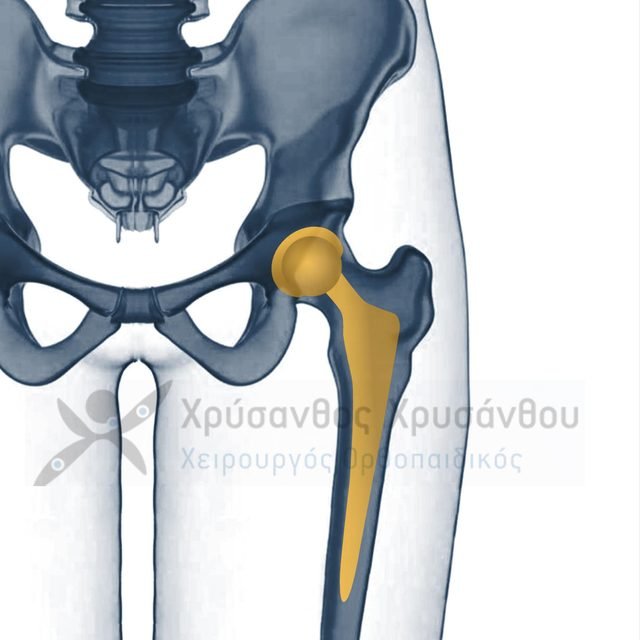
The three types of hip operation
Total hip replacement
WHAT IT IS
Both surfaces of the joint are replaced: the worn femoral head with a stem and head, and the acetabulum with a cup and special insert. It is one of the most successful operations in modern medicine — with MAKO robotic assistance and minimally invasive approaches, accuracy and respect for the tissues are maximised.
HOSPITAL STAY
Usually 2–3 nights. Standing and walking with an aid from the very first day — early mobilisation is part of the protocol.
Hip resurfacing replacement
WHAT IT IS
The femoral head is not removed — it is “capped” with a metal cover, while a thin cup is placed in the acetabulum. It offers maximum bone preservation and stability, allowing high activity levels. It is aimed at carefully selected patients — typically younger, active men with good bone stock — as suitability is judged by strict criteria.
HOSPITAL STAY
Usually 2–3 nights, with early mobilisation as in the total replacement.
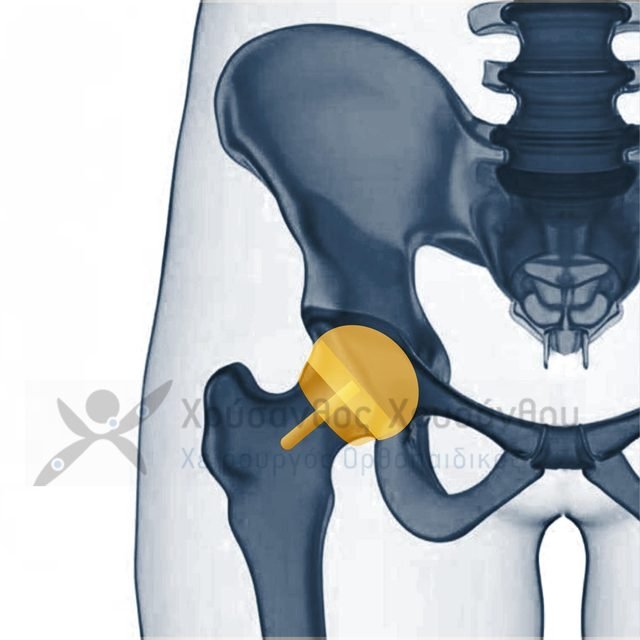
Revision hip replacement
WHAT IT IS
The replacement or correction of a previous replacement that developed a problem: loosening or wear, recurrent dislocations, periprosthetic fracture or infection. A complex operation involving removal of the old materials, reconstruction of bone defects (with grafts where needed) and special revision implants. It demands specialist experience and meticulous pre-operative planning.
HOSPITAL STAY
Longer — usually 3–5 nights, with an individualized rehabilitation program depending on the cause.
MAKO robotic assistance — the difference in the hip
Dr. Chrysanthou trained on the MAKO SmartRobotics system at Stryker’s facilities in Florida, USA. With MAKO, the operation is planned pre-operatively on a three-dimensional model from the patient’s CT scan: the acetabular cup is placed at the exact planned angles, while leg length and hip geometry are restored with millimetre predictability — factors that reduce the risk of dislocation and leg-length discrepancy and allow early mobilisation, often from the first day. αποκαθίστανται με προβλεψιμότητα χιλιοστού — παράγοντες που μειώνουν τον κίνδυνο εξαρθρήματος και ανισοσκελίας και επιτρέπουν ταχεία κινητοποίηση, συχνά από την πρώτη ημέρα.

What you should know — before & after the operation
Before the operation
- Full pre-operative work-up and anaesthetic assessment; treat sources of infection (teeth, urinary tract).
- Tell us about all your medication — especially anticoagulants and antiplatelets.
- A CT scan for the MAKO robotic plan — done before the operation.
- Prepare your home: a high, stable chair with arms, removal of rugs/cables, a raised toilet seat and an aid for socks/shoes if advised.
- Arrange transport and help for the first 1–2 weeks.
After the operation
- Standing and walking with an aid from day one; gradual progression to crutches and then without an aid.
- Thromboprophylaxis: anticoagulation and compression stockings for the period your doctor specifies.
- Follow the hip precautions in the first weeks (see below) — individualised according to the approach.
- Waterproof dressing on the wound; sutures/clips removed at 10–14 days.
- Daily strengthening exercises (especially the abductors) and walking increasing distances; follow-ups at 2–3 and 6 weeks.
The precautions of the first weeks. Until you are given the “all clear”: no hip flexion beyond 90° (deep, low seats), no crossing the legs, no sudden twisting of the trunk over the fixed leg — and, when sleeping, a pillow between the knees. The instructions are individualised according to the surgical approach.
The recovery journey — indicative timeline
Day 0–1
Standing and first steps with an aid — early mobilisation
Weeks 1-2
At home with crutches; hip precautions; sutures 10–14 days
Weeks 2-6
Gradual weaning off aids; driving ~4–6 wks once approved
Weeks 6-12
Desk work, walking, swimming, cycling; precautions relaxed on instruction
Months 3–12
Full activity and gentle sports; improvement continues up to 12 months
In revision, the timings and precautions are fully individualised by the surgeon.
Safety & possible complications
Total hip replacement has been called “the operation of the century” for its effectiveness — but, like any surgery, it carries risks you should be aware of.
• General — any operation
Pain & swelling
Ελέγχονται με τακτική αναλγησία και υποχωρούν σταδιακά τις πρώτες εβδομάδες.
Thrombosis (DVT / pulmonary embolism)
Systematically prevented with anticoagulation, stockings and early mobilisation.
Infection
Superficial or, more rarely, deep; report fever, redness or discharge immediately.
Bleeding
Significant bleeding or the need for transfusion is rare.
Neurovascular injury
Small risk to the nerves of the area (mainly the sciatic); usually temporary symptoms.
Anaesthetic
Nausea relatively common; serious complications very rare.
• pecific — hip replacement
Εξάρθρημα
Mainly in the first weeks; robotically accurate cup placement and following the precautions substantially reduce it.
Leg-length discrepancy
A small length difference may be noticeable, usually temporarily; the robotic plan aims precisely at restoring length.
Limp / abductor weakness
Improves with the strengthening programme over the first months.
Loosening / wear over time
Modern implants have excellent longevity — the great majority work perfectly for 15–20+ years.
Periprosthetic fracture
Heterotopic ossification
Bone formation in the soft tissues around the hip; rarely clinically significant.
Frequently asked questions
01 When will I walk after the operation?
The same or the next day, with a physiotherapist and a walker or crutches. Early mobilisation reduces the risk of thrombosis and speeds up recovery — and this is where the minimally invasive, robotically planned operation makes a noticeable difference.
02 What do I gain from MAKO in the hip?
Three-dimensional planning from your own CT scan, placement of the cup at the exact planned angles and restoration of leg length with millimetre accuracy. In practice: a lower risk of dislocation and leg-length discrepancy, less tissue trauma, a more predictable outcome.
03 Total or resurfacing — how is it decided?
Resurfacing preserves the femoral head and more bone, and suits carefully selected, younger and active patients — typically men with good bone stock and suitable anatomy. For most patients, total replacement remains the treatment of choice. The decision is made individually, with strict criteria.
04 Which movements should I avoid and for how long?
In the first weeks: no hip flexion beyond 90° (low seats, deep bending), no crossing the legs, no sudden twisting of the trunk over the leg. For socks and shoes, use the aids you will be shown. The precautions are individualised according to the surgical approach and are relaxed gradually on your doctor’s instruction — usually after 6 weeks.
05 How will I sleep?
At first on your back, with a pillow between the knees. Sleeping on your side is allowed gradually — initially on the healthy side, always with the pillow between the legs — according to the instructions you receive.
06 How long does a hip replacement last?
Modern implants have excellent longevity: according to international registries, the great majority work perfectly for more than 15–20 years. Accurate placement — where MAKO helps decisively — and a healthy body weight prolong it.
07 When can I drive?
Usually at 4–6 weeks, once you have stopped strong painkillers and fully control the leg, including an emergency stop — always with your doctor’s approval. Also inform your insurance company.
08 Which sports can I return to?
Low-impact activities are encouraged: walking, swimming, cycling, golf, gentle hiking, dancing. Running, jumping and sports with sudden turns are best avoided consistently. After hip resurfacing, in selected patients, the activity limits may be wider — this is individualised.
09 Will it set off airport scanners?
Probably yes — metal implants are often detected at security gates. No special certificate is needed; simply inform the staff. A copy of an X-ray on your phone is enough, just in case.
10 When will I see the doctor again?
Wound check and suture removal at 10–14 days, review at 2–3 and 6 weeks, and then regular radiological monitoring of the implant at wider intervals. Report fever, increasing pain, redness or discharge from the wound immediately.
Why choose Dr. Chrysanthou
Certified MAKO SmartRobotics Hip & Knee training at Stryker’s facilities in Florida, USA (with recent MAKO Total Hip 4.0 certification, 2023) and 17+ years of experience in elective replacement, operating at the Interbalkan Medical Center in Thessaloniki and at partner clinics in Athens — from primary total replacement to complex revision.
Hip pain has a definitive solution. Start with an assessment.