Total Elbow Replacement
Total elbow replacement replaces the damaged joint with an artificial implant, providing significant pain relief and a functional range of motion for everyday activities.
When it is indicated
- Rheumatoid arthritis with severe joint destruction
- Post-traumatic arthritis and stiffness
- Complex fractures broken into several pieces (comminuted), in older patients
- Non-union (a fracture that has failed to heal) or failure of previous fixation
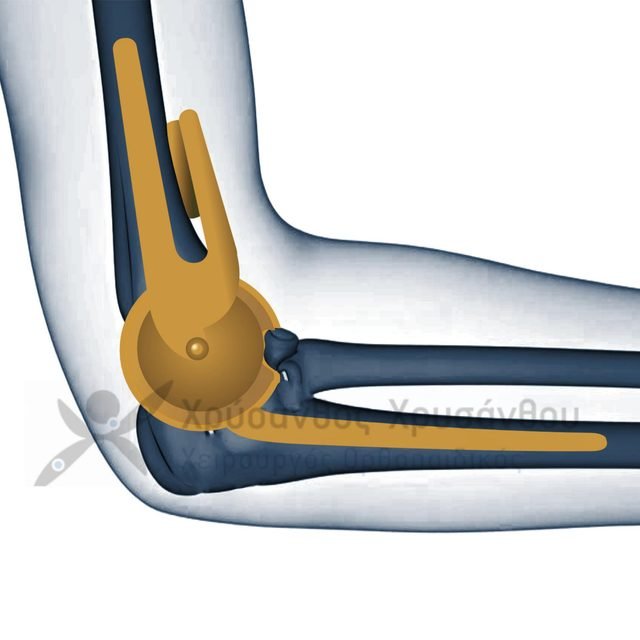
The operation
The worn joint surfaces are replaced with artificial components of metal and special plastic: one is placed in the humerus and one in the ulna, forming a stable hinge joint that allows flexion and extension. The approach is through an incision at the back of the elbow. Various implant types exist — the choice is individualised according to bone quality and quantity, and in special cases a custom implant can be designed from a CT scan of the elbow. The primary goal is pain relief and improved quality of life.
Hospital stay: the aim is discharge within a few days (usually 1–3), provided pain is controlled, the wound is clean, you can mobilise safely and you have understood your exercises and precautions.
What you should know — before & after the operation
General information — each patient receives individualised instructions from their doctor, physiotherapist and occupational therapist.
Before the operation
- Pre-operative work-up and anaesthetic assessment to confirm you are fit for surgery.
- Hormonal preparations (contraceptives, HRT): may need to be stopped about 6 weeks beforehand — always in consultation with your doctor.
- Rheumatoid arthritis: disease-modifying and biologic drugs (DMARDs, TNF inhibitors) increase infection risk — consult your rheumatologist about possible adjustment.
- Remove nail varnish, gel or artificial nails (they affect anaesthetic monitoring) and any jewellery from the operated limb.
- Arrange transport and help at home — you will function with one arm for several weeks.
After the operation
- The arm is supported in a sling; because of the nerve block it may be numb and “heavy” for the first 24 hours.
- A night extension splint is often made, alternating with the sling during the day.
- Stockings and compression devices on the legs to prevent thrombosis; mobilise as soon as possible.
- Waterproof dressing on the wound — shower rather than bath, no direct water on the area. Sutures are usually absorbable; wound check at 10–14 days.
- Loose, front-fastening clothes; dress the operated arm first, undress it last. Sleep on your back, with a pillow behind the arm.
Η πορεία της αποκατάστασης — ενδεικτική χρονογραμμή
Weeks 0–6 · Protection
Sling at all times, night extension splint, no active use or loading — only the guided exercises
Weeks 6–12
Gradual weaning off the sling; light use at waist/chest height (a glass, writing) — still no loading
Weeks 12+
Return to usual activities within tolerable limits; light loading (opening a door, support)
Months 3+
Swimming, light gym, gentle gardening — always after consultation
The phases and restrictions are set by the surgeon in the operative note and individualized by your therapist.
The 5 kg rule — for life. To protect the implant, permanently avoid lifting objects heavier than 5 kg (about a full kettle), heavy manual work and digging, as well as sports that strain the arm, such as racquet sports. This reduces the risk of loosening or dislocation of the implant.
Safety & possible complications
Every operation carries some degree of risk — it is important to be aware of them. Feel free to ask anything that concerns you.
• any operation
Infection
All precautions are taken (antisepsis, sterile field). A superficial wound infection is usually treated with oral antibiotics.
Deep vein thrombosis (DVT)
A clot in the leg veins; prevented with stockings, compression devices, early mobilisation and — where needed — anticoagulation. Rarely, part of a clot can travel to the lungs (pulmonary embolism), which is why prevention is systematic.
Anaesthetic
Feeling sick (nausea) and generally unwell is relatively common; serious complications (heart, breathing, nervous system) very rare.
• elbow replacement
Stiffness
May appear after surgery; managed with the therapeutic exercise programme.
Nerve / vascular injury
Small risk around the elbow (especially the ulnar nerve); if it occurs it is investigated carefully and treated appropriately to restore function.
Periprosthetic fracture
A fracture of the adjacent bone can be managed directly, conservatively with a splint, or with a further operation.
Implant loosening
Over years and with use, the implant may loosen (less often due to infection) and need a corrective operation — hence the lifelong 5 kg rule.
Frequently asked questions
01 Will I be in pain after the operation?
To control pain, a combination of general anaesthesia and a regional nerve block (local anaesthetic around the nerves of the arm) is usually given — this is why the arm is numb and “heavy” for the first 24 hours. Afterwards pain is controlled with regular analgesia. Bruising and swelling gradually subside within a few weeks.
02 What is the night extension splint?
A light splint that holds the elbow in extension during sleep, protecting the operation and preventing stiffness. You wear it at night and alternate it with the sling during the day — your therapist shows you step by step how it goes on and off, always with the arm supported on pillows.
03 When do exercises start?
Immediately — but only as your physiotherapist guides you. Neck, shoulder, wrist and fingers move freely from the start. For the elbow, assisted flexion-extension and forearm rotation exercises are done (e.g. 5 repetitions, 2–3 times a day), with the arm supported — never forcing the movement. After 6 weeks the programme progresses with your therapist.
04 How will I dress and wash?
Prefer a shower to a bath, with the waterproof dressing in place and no direct water on the wound — a simple collar & cuff support may be given for showering. Loose, front-fastening clothes, without small buttons and zips, and easy-to-wear shoes. Always dress the operated arm first and undress it last. Take care with balance while wearing the sling.
05 How will I sleep?
Avoid lying on the operated arm — lying on your back is usually the most comfortable, with a pillow behind the arm so it does not “fall” backwards, and the night splint in place. Rest and good-quality sleep are essential for healing.
06 How will I manage at home with one arm?
Prepare in advance: ready meals or ingredients that need minimal preparation, kitchen aids (easy-grip jar openers, etc.) and help from a family member for the first weeks. Avoid heavy household chores for about 12 weeks.
07 When do I return to work?
Roughly after about 6 weeks for sedentary work. If your job involves lifting, manual work or overhead activities, the period is considerably longer — discuss it individually with the team.
08 When can I drive?
Not before you are finally out of the sling, with pain settled and confident that you fully control the vehicle in an emergency — roughly around 10 weeks, always confirmed by your doctor. Also inform your insurance company so your cover remains valid.
09 How much weight can I lift?
From 12 weeks onwards, very light weights — with a permanent upper limit of 5 kg (about a full kettle or a light vacuum cleaner). Permanently avoid forceful pushing, heavy manual work and racquet sports.
10 When will I see the doctor again?
The wound is checked at 10–14 days, and the first routine follow-up at the clinic is usually scheduled about 6 weeks after surgery. Report fever, marked redness, swelling or discharge from the wound immediately.
Why choose Dr. Chrysanthou
Sub-specialisation in upper-limb surgery with certification in shoulder & elbow surgery and 17+ years of experience in joint replacement, complex reconstructive surgery and post-traumatic conditions — a demanding field where specialisation matters.
Chronic pain or limited elbow movement? Let’s look at your options.