Shoulder Replacement
Shoulder replacement replaces the worn joint surfaces, relieving chronic pain and restoring movement and function of the upper limb.
When it is indicated
- Advanced osteoarthritis of the shoulder
- Rotator cuff arthropathy (irreparable tears with arthritis)
- Rheumatoid arthritis and other inflammatory joint conditions
- Post-traumatic arthritis and the after-effects of old fractures
- Osteonecrosis of the humeral head (loss of blood supply to the “ball” of the shoulder)
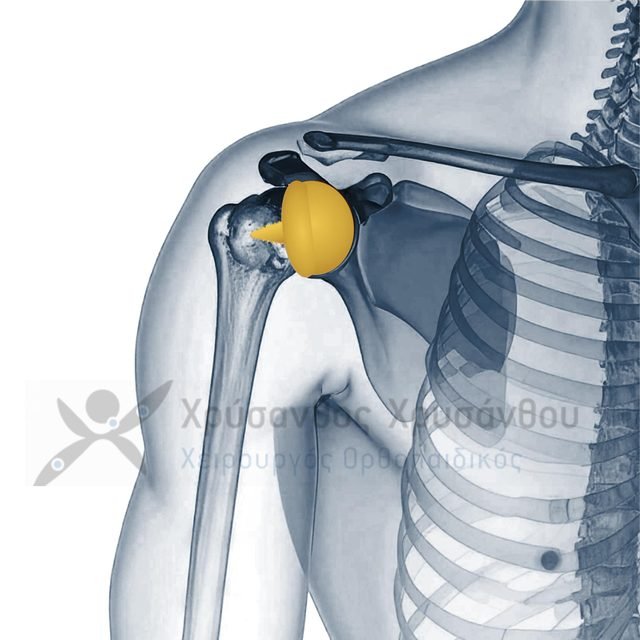
The three types of shoulder replacement
Depending on the condition, bone quality and the state of the rotator cuff, one of the following types is chosen. The decision is individualised after a full clinical and imaging assessment.
Total (anatomic) shoulder replacement
What it is
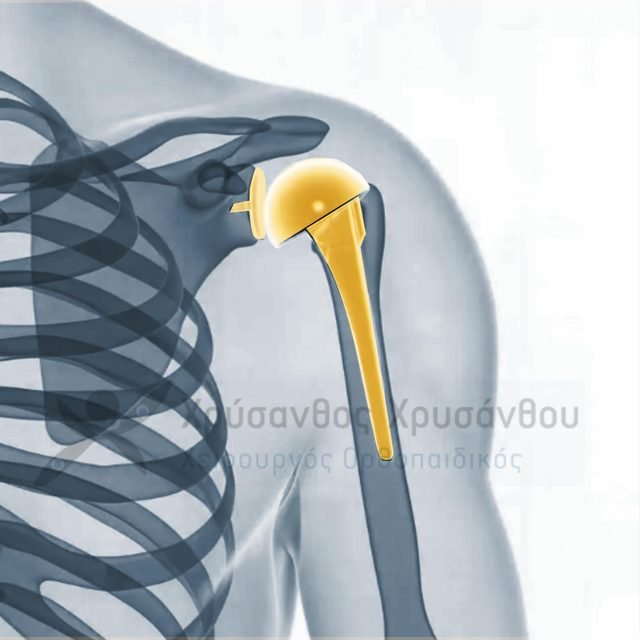
Both joint surfaces are replaced: the humeral head with a metal head on a stem, and the glenoid with a special insert. It reproduces the natural anatomy of the shoulder and is chosen when the rotator cuff is functional — typically in advanced osteoarthritis.
Hospital stay
Usually 1–2 nights, depending on the patient’s general condition. Mobilisation exercises begin on the very first day, with the arm in a sling.
Shoulder resurfacing replacement
What it is
Only the worn surface of the humeral head is replaced with a metal cap, without a stem — preserving maximum bone. It is aimed mainly at younger, active patients with good bone stock and a functional rotator cuff, keeping all future options open.
Hospital stay
The shortest of the three — usually 1 night, with immediate start of exercises and faster overall recovery, as the operation is less extensive.
Reverse shoulder replacement
What it is
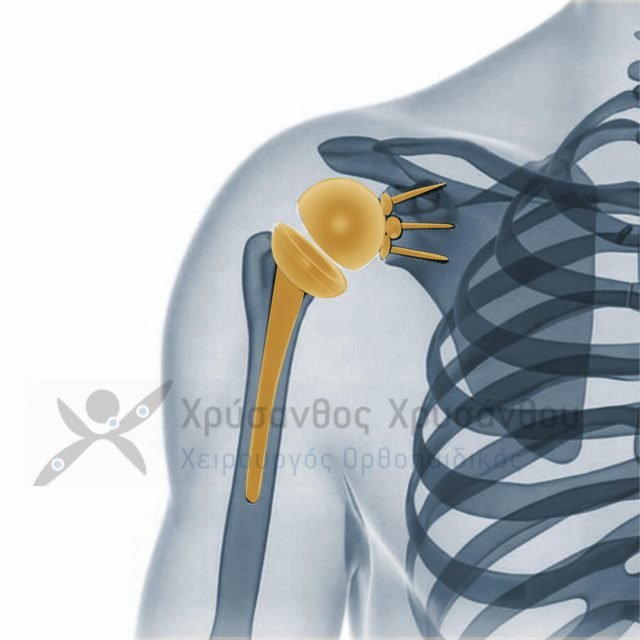
The joint geometry is reversed: the ball is placed on the glenoid and the socket on the humerus. This lets the deltoid muscle take over lifting the arm — the treatment of choice when the rotator cuff is deficient: cuff arthropathy, irreparable tears, complex fractures and revisions of previous operations.
Hospital stay
Usually 1–3 nights, depending on the indication and general condition. A sling follows, along with a gradual, guided exercise programme.
What you should know — before & after the operation
The following information is general and applies to all types of shoulder replacement. Each patient receives individualised instructions from their doctor and physiotherapist.
Before the operation
- Full pre-operative work-up and anaesthetic assessment.
- Tell your doctor about all medication you take — especially anticoagulants and antiplatelets.
- Arrange help at home for the first weeks: initially you will effectively use one arm.
- Get loose, front-fastening clothes — dress the operated arm first and undress it last.
- Arrange transport home from the clinic — driving is not allowed.
After the operation
- A sling for a period set by your doctor (usually 2–6 weeks depending on the case), removed for exercises.
- Exercises from day one with a physiotherapist and daily continuation at home — this is the key to the result.
- Wound care: a waterproof dressing in the shower, no soaking or rubbing until fully healed.
- Regular pain relief and ice packs (up to 20 minutes, with a towel) in the first days to control pain and swelling.
- Follow-up usually 2–3 weeks later; non-absorbable sutures are removed at 10–14 days.
Ασφάλεια & πιθανές επιπλοκές
Οι αποφάσεις για χειρουργική θεραπεία λαμβάνονται από κοινού, από τον χειρουργό και έναν σωστά ενημερωμένο ασθενή. Κάθε επέμβαση ενέχει κάποιον βαθμό κινδύνου — η ομάδα μας κάνει ό,τι είναι δυνατόν για να τον ελαχιστοποιήσει, και οφείλετε να γνωρίζετε τα παρακάτω. Μη διστάσετε να ρωτήσετε ό,τι σας απασχολεί, όσο «ασήμαντο» κι αν σας φαίνεται.
• καθε χειρουργειου ωμου
Πόνος
Μετεγχειρητικός πόνος υπάρχει και ελέγχεται με τακτική αναλγησία· διαφέρει ανά ασθενή και τύπο επέμβασης.
Δυσκαμψία
Το εύρος κίνησης μπορεί να μην επανέλθει πλήρως στο φυσιολογικό — το αναμενόμενο εύρος συζητείται εκ των προτέρων.
Αιμορραγία
Μικρή διαρροή από το τραύμα είναι συνήθης· η ανάγκη μετάγγισης είναι απίθανη αλλά όχι αδύνατη.
Λοίμωξη
Στο τραύμα ή σε βάθος στην άρθρωση. Η έγκαιρη διάγνωση έχει σαφώς καλύτερη έκβαση — γι’ αυτό ενημερώνετε άμεσα για πυρετό, ερυθρότητα ή έκκριση. Συνήθως αντιμετωπίζεται με αντιβίωση· σπανίως απαιτείται νέα επέμβαση.
Δυσμορφική ουλή
Οι περισσότερες ουλές εξελίσσονται σε λεπτή, ωχρή γραμμή εντός ενός έτους· υπάρχουν θεραπείες βελτίωσης.
Νευρική βλάβη
Σπάνια στις συνήθεις επεμβάσεις· ο κίνδυνος είναι υψηλότερος σε αναθεωρήσεις και σύνθετα κατάγματα.
Αγγειακή βλάβη
Πολύ χαμηλός κίνδυνος· αυξημένος σε συγκεκριμένα κατάγματα και επανεπεμβάσεις.
Αναισθησιολογικές
Ναυτία και αδιαθεσία είναι σχετικά συχνές· σοβαρές επιπλοκές (καρδιά, πνεύμονες, νευρολογικές) είναι πολύ σπάνιες.
• αρθροπλαστικης ωμου
Φθορά / χαλάρωση εμφυτεύματος
Σχεδόν όλες οι αρθροπλαστικές έχουν πεπερασμένη διάρκεια ζωής. Οι περισσότεροι ασθενείς δεν θα χρειαστούν ποτέ αναθεώρηση — η χαλάρωση, όταν συμβεί, εμφανίζεται κατά κανόνα πολλά χρόνια μετά.
Μικρότερη «ζωή» σε νεότερους
Η διάρκεια ζωής του εμφυτεύματος είναι μικρότερη σε νεότερους ασθενείς, σε προϋπάρχουσα οστική απώλεια και σε αναθεωρήσεις.
Αναθεώρηση (revision)
Αν χρειαστεί, τα αποτελέσματα είναι γενικά λιγότερο ευνοϊκά και οι κίνδυνοι υψηλότεροι σε σχέση με την αρχική επέμβαση.
Εξάρθρημα πρόθεσης
Πολύ ασυνήθιστο· ενδέχεται να απαιτήσει περαιτέρω χειρουργική αντιμετώπιση.
Περιπροθετικό κάταγμα
Κάταγμα των οστών κατά ή μετά την αρθροπλαστική είναι πολύ σπάνιο, αλλά μπορεί να χρειαστεί χειρουργική θεραπεία.
The recovery journey — indicative timeline
Weeks 0–2+
Sling, exercises from day 1
Weeks 3–6
Return to desk work, light tasks
Months 3–4
Swimming, golf, gentle sports
Months 3–6
Manual work, lifting, overhead movement
Months 12–24
Times are indicative and individualised. Driving: after the sling is finally removed and once you have full control of the vehicle. Most benefits are felt within the first six months.
Contact your doctor immediately if you develop fever, severe or increasing pain, redness, swelling or discharge from the wound.
Before you decide
Alternatives to surgery
The decision to operate is each patient’s personal choice, in consultation with their surgeon. Very few operations are “essential” — and all carry some degree of risk. Many patients learn to manage their symptoms with pain relief and improve function with muscle strengthening and physiotherapy. Surgery will be recommended only if it is judged that it will genuinely improve your symptoms. Before you decide, make sure you have answers to three key questions:
Frequently asked questions
01 Will I be in pain after the operation?
Although the aim of surgery is pain relief, it may take a few weeks before you feel the benefit. A local nerve block is often given, so the arm may be “numb” for the first 24 hours — that is why it is important to start pain relief regularly from the outset, so pain stays controlled and you can do your exercises. Bruising and swelling of the shoulder/arm gradually subside over a few weeks; ice packs help.
02 Will I need a sling and for how long?
Yes — for at least the first 2 weeks, to protect the operation during early healing and for comfort. The physiotherapist will show you how to put it on and take it off, and will guide you in gradually weaning off it as the soft tissues heal and the muscles strengthen.
03 When do exercises start and for how long?
From the very first day after surgery, guided by a physiotherapist. You continue at home with short, frequent sessions (e.g. 5–10 minutes, 4 times a day) for several months — exercises prevent stiffness, strengthen the muscles and are the key to maximum benefit. Mild pulling or discomfort during exercise is normal; severe pain that persists means less intensity or frequency.
04 How do I care for the wound?
You will leave the clinic with a waterproof dressing and spares for home. You may shower with the dressing on, but do not let water run directly onto the shoulder and do not soak it in a bath; pat dry, without rubbing. Non-absorbable sutures are usually removed at 10–14 days. Avoid spray deodorants, powders or perfumes near the wound until fully healed.
05 What should I avoid at first?
For the first 3 weeks only very gentle daily activities — in particular avoid movements that take the elbow away from the body. Keep the sling on except during exercise times. Do not put all your weight on the arm with the palm behind you (e.g. to get up from a chair). When the physiotherapist allows you to remove the sling, do not be afraid to move the arm — over time the movements become less and less painful.
06 How does recovery progress?
In three stages. Stage 1: sling, no movement other than exercises — you effectively function with one arm, so plan help with dressing, shopping and cooking. Stage 2: gradual weaning off the sling and use of the arm at waist height for light tasks. Stage 3: strengthening and arm-elevation exercises. The greatest improvement is felt in the first six months, but strength and movement keep improving for up to 18–24 months.
07 When do I return to work?
It depends on the type: light sedentary work usually at 3–6 weeks; manual work, lifting or overhead activities at 3–6 months, always in consultation with your doctor and physiotherapist.
08 When can I drive?
Not while you are wearing the sling. After that, you must be in full control of the vehicle at all times — discuss it with your team and inform your insurance company about the operation.
09 How long does a shoulder replacement last?
Almost all replacements have a finite lifespan, but most patients will never need a revision. Wear or loosening, when they occur, usually appear several years later. Lifespan is shorter in younger patients, with pre-existing bone loss and in revisions.
When will I see the doctor again after the operation?
The first follow-up is usually scheduled 2–3 weeks after discharge, to check progress and the wound. There you discuss any questions or concerns, and the next appointments are set as needed.
Why choose Dr. Chrysanthou
The shoulder is at the core of his sub-specialty: upper-limb surgery fellowship at Royal Liverpool & Broadgreen (UK), the post of Honorary Consultant Orthopaedic & Upper Limb Surgeon at Southend University Hospital in the NHS, certification in shoulder & elbow surgery, Head of the Upper Limb Unit at the Interbalkan Medical Center and 17+ years of experience across arthroscopic, joint replacement and complex reconstructive shoulder surgery — so that replacement is chosen only when it is truly needed.
Do you have shoulder pain or stiffness? Start with a full assessment.